
U.S. equities delivered another solid year in 2025, with the S&P 500 posting a high-teens total...
A Strong Market Beneath the Headlines
October was an interesting month for investors. While many of the market's largest companies struggled, most of the broader stock market performed quite well. Concerns about the enormous spending associated with artificial intelligence weighed on technology shares, but strength across most other sectors reflected an economy that continues to grow, healthy corporate earnings, and declining bond yields.
Looking only at the major indexes, you might have missed much of that strength.
Stock Market Performance: A Tale of Two Markets
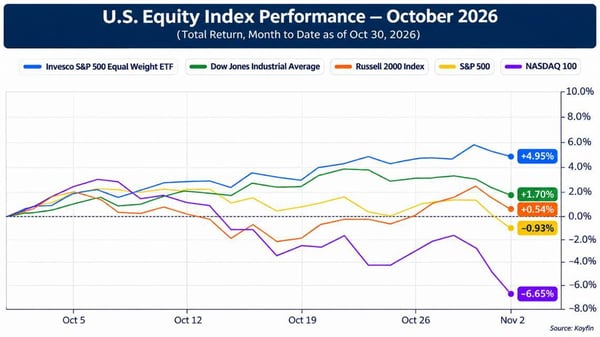
The S&P 500 declined 0.9% during October, while the tech-heavy Nasdaq-100 fell 6.7%. The Dow Jones Industrial Average gained 1.7%, and the Russell 2000 Index of smaller companies rose modestly.
Perhaps the most interesting comparison was the equal-weight S&P 500, which gained about 5%. Unlike the traditional S&P 500, where the largest companies have the greatest influence, the equal-weight index gives every company the same weight.
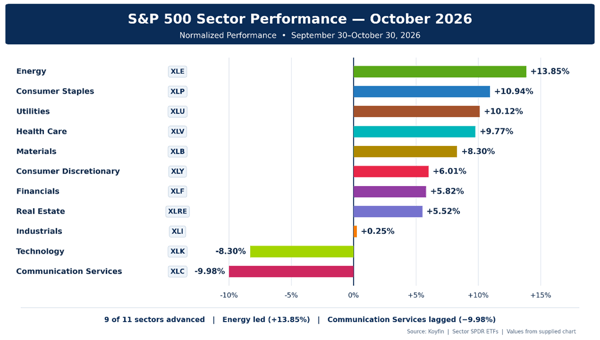
The difference was striking as the sector level, as well. Nine of the S&P 500's eleven sectors advanced during October, with several posting double-digit gains. Strength was evident across both economically sensitive and traditionally defensive sectors. Technology and communication services were the exceptions, as investors became increasingly concerned about the outlook for AI spending.
This wasn't a market where investors were broadly selling stocks. They were simply finding opportunities elsewhere.
Technology: Great Opportunities, but Important Questions
The largest technology companies continue pouring extraordinary amounts of money into data centers, semiconductors, and the power infrastructure needed to support artificial intelligence. Amazon alone has indicated that its 2026 cash cap-ex will total approximately $220 billion.
For much of the AI investment cycle, investors rewarded companies for announcing bigger spending commitments. The assumption was that more investment would ultimately mean more growth. Now investors are asking a reasonable question: When will all that spending translate into profits and free cash flow?
Earnings disappointments and cash-flow concerns at several technology companies brought those questions into sharper focus late in October. Selling spread across portions of the semiconductor and AI infrastructure industries.
We continue to see tremendous long-term opportunities in artificial intelligence. But we also recognize that some of the companies spending the most money today won't necessarily be the ones earning the greatest returns tomorrow. There's a big difference between an exciting growth opportunity and an attractive investment at a particular price.
We continue to maintain meaningful technology exposure and see considerable long-term opportunities in the companies we own. However, we're selective about those holdings, focusing on competitive advantages, earnings potential, and valuations that make sense. We also maintain diversified positions in areas such as healthcare and utilities, which can benefit from different economic conditions.
Corporate Earnings and Valuations: Still Encouraging
Despite the weakness in technology shares, corporate earnings have been quite strong.
According to FactSet, 60% of S&P 500 companies had reported third-quarter results as of October 30, with 82% exceeding analysts' earnings expectations.
Overall earnings growth was running at approximately 30.2% compared with a year earlier. Even excluding the Energy sector, LSEG estimated earnings growth of 26.4%. All eleven sectors were reporting year-over-year earnings growth.
There is one qualification. Although most companies are beating expectations, aggregate earnings have come in just 1.9% above estimates, compared with a five-year average surprise of 7.5%. A substantial one-time legal charge at Meta weighed on that result.
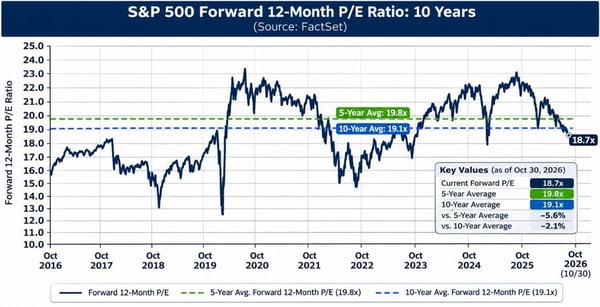
Valuations have also become more reasonable. The S&P 500 now trades at approximately 18.7 times expected earnings over the next twelve months, below its five-year average of 19.8 times.
We find that combination encouraging. Earnings are growing at a healthy pace, while investors are paying less for those earnings than they have, on average, over the past five years. Of course, much depends on companies delivering the growth analysts expect.
The Economy: More Resilient Than Many Expected
The economic data released during October continued to show surprising strength.
Real GDP grew at a 3.4% annualized rate during the third quarter, up from 2.2% in the second quarter. Consumer spending and business investment both contributed. One particularly encouraging measure was real final sales to private domestic purchasers, which increased 4.9%. This measure strips out government spending, inventories, and net exports, giving us a clearer picture of underlying private-sector demand.
Business surveys told a similar story. September's ISM manufacturing and services indexes came in at 54.5 and 54.9, respectively. Both were comfortably above 50, indicating expansion.
The labor market is a little more complicated. September payrolls increased by only 29,000, and unemployment edged up to 4.2%. However, the household survey showed employment increasing by 406,000, while initial unemployment claims remained historically low.
Our interpretation is that companies have become more cautious about hiring, but they aren't broadly laying off workers either.
Inflation remains stubborn. September's Consumer Price Index increased 3.7% from a year earlier, driven in part by higher fuel prices. Core PCE inflation, which excludes food and energy, remained at 3.1%.
Nevertheless, we continue to believe the underlying economy is strong. Consumer spending, business activity, and corporate profitability have held up remarkably well despite higher interest rates.
Interest Rates and Credit: Our Duration Extension
October also brought a meaningful decline in Treasury yields. The 10-year Treasury yield fell from 5.29% at the end of September to 4.94% on October 30, a decline of roughly 35 basis points. The two-year yield also declined, from 4.91% to 4.56%.
At its October 28 meeting, the Federal Reserve voted 10–2 to leave the federal funds rate unchanged at 3.75%–4.00%. Both dissenting members favored a 25-basis-point increase.
Inflation is still above the Fed's target, so additional tightening remains likely in December. However, we believe the Fed's measured approach reduces the risk of raising rates too aggressively and unnecessarily slowing the economy.
Early in October, our portfolio management team extended fixed-income duration because we believed longer-term Treasury yields were approaching their peak. That decision has worked in our favor as yields subsequently declined. Longer-duration bonds generally benefit more from falling interest rates.
We don't view the recent decline in longer-term rates as necessarily signaling economic weakness. Rather, we believe yields were approaching levels that naturally began to restrain demand and inflation expectations. In our view, that created an attractive opportunity to extend duration.
Credit markets have also become somewhat more cautious. Corporate credit spreads widened modestly, with investment-grade spreads near 0.89 percentage points and high-yield spreads around 3.26 percentage points as of October 29.
Even with the recent widening, both remain relatively low by historical standards. That's consistent with an economy where investors aren't anticipating widespread financial difficulties. Still, with spreads relatively narrow, we're selective about the credit risks we take.
Looking Ahead
November begins with another busy week of economic reports and corporate earnings.
Employment will be particularly important. September's modest payroll gain lowered the three-month average to approximately 51,000 jobs. Yet the household survey and historically low unemployment claims suggest the labor market remains relatively stable. We'll be watching to see whether October brings a rebound in hiring.
Manufacturing and services reports will also provide an update on business activity, particularly whether companies are continuing to expand despite higher input costs.
On the earnings front, reports from AMD, Qualcomm, Arm, and other technology companies should shed more light on AI infrastructure demand, capital spending, and profitability.
The November 3 midterm elections and geopolitical developments could also influence financial markets, particularly through their potential effects on energy prices and inflation. While high energy prices are increasingly flowing deeper into the economy, any reaction to the election is likely to be temporary.
Our outlook remains positive. The economy continues to grow, corporate earnings are strong, and the broadening of stock market performance is encouraging. We expect technology to remain an important source of long-term opportunity, but we're being selective about where we invest. At the same time, our diversified equity holdings and longer-duration fixed-income positions give us exposure to opportunities beyond the largest technology companies.
The question going forward is whether the economy and corporate earnings can continue growing without inflation forcing the Federal Reserve to become substantially more restrictive. So far, the economic data suggest there's still room for growth.